The Prisoner at 60
The Village Experience in VR

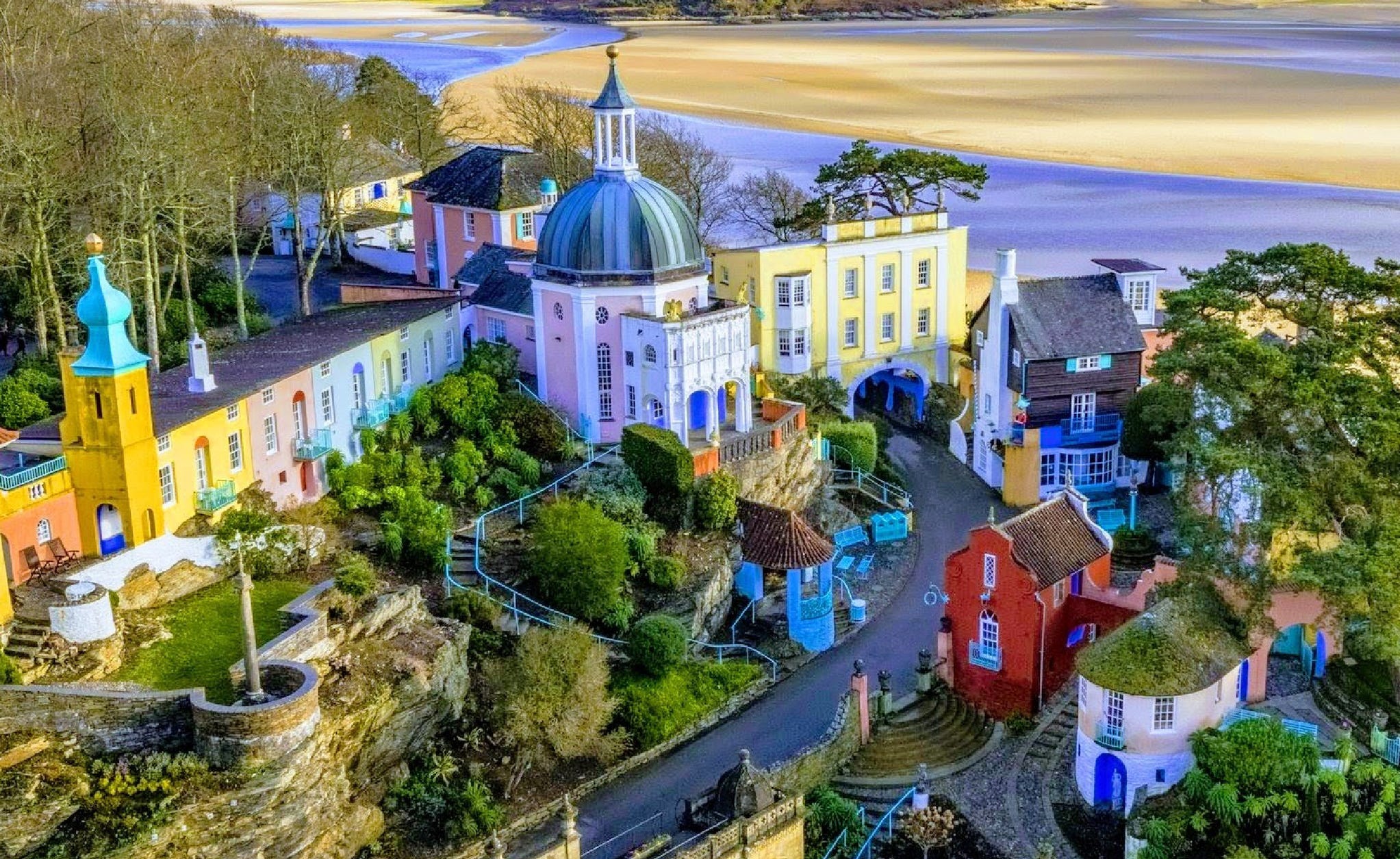
The Prisoner was filmed, partly, in a real village. Portmeirion is a tourist village in Gwynedd, North Wales. It lies on the estuary of the River Dwyryd in the community of Penrhyndeudraeth. The architecture is eccentric, even whimsical, evoking a classic Meditaerranean settlement, full of color and embellishments.
It was the perfect setting for The Prisoner, with its strange and inviting surface concealing an evil intent.
Its reality also puts The Village in the Google Streetview database. Hi-res images of Prisoner locations can be imported into a virtual world. So can accurate 3D models — of #6’s cottage, #2’s place, the yellow and green Lotus Seven. And yes, Rover.
Because we could recreate these iconic elements of The Prisoner — we decided we would.
Who Are We?
VR is something like The Village. It is a social setting in which the participants are not who they appear to be. In some cases, this fact does conceal malign intent, but in my experience destructive impulses are the exception in VR, not the rule, as in The Prisoner’s Village,.
For me, VR has been a place to work on projects, to find friendships, and to be part of a community. I give in VR by building worlds to share and by hosting events that some people find meaningful.
One type of event that works well in VR is watching and discussing media. One of my friends is an astute commentator who has led appreciative audiences through such discussable TV classics as, Startrek, The Next Generation and Firefly, not to mention challenging books such as Bessel van der Kock’s, The Body Keeps the Score.
I’m old enough to have watched The Prisoner when it hit UHF stations in the U.S. during the early 1970s. My astute friend Scott isn’t, which is why I am especially looking forward to his observations as a first-time viewer now.
Another one of my friends builds models and worlds at the highest level, in VR. Scott and I can build. Our friend Fuzz brings objects to life. You haven’t really had the full Firefly experience until you’ve discussed it with others inside ‘Serenity,’ by Fuzz.
What I bring to the team is less obvious. As a host, I’m pretty good at getting folks involved. I also came of age during the 1960s and have a perspective on the era that informs my view of The Prisoner. I even lived in London when Patrick McGoohan was beloved as Danger Man and, well, not so beloved, as The Prisoner. I didn’t understand either of those strong feelings at the time and I still don’t entirely.
What is ‘The Prisoner’?
England in the early sixties was losing its Empire, becoming a full-on surveillance state under the auspices of the National Health Service, and happily commoditizing its youth rebellion. You could buy Mods and Rockers clothes on Carnaby Street. You could listen to The Beatles and The Rolling Stones and The Who in a booth at the record store.
By 1964, you buy those clothes everywhere in the world and the music became, ‘The British Invasion.’
One English response to England’s declining dominance was to pretend it wasn’t happening. Cultural hegemony was one approach. An astonishing set of suave and sophisticated make-believe spies was another. With John Steed and Emma Peel out there, it was easy to imagine England still in control. Throw in The Saint, maybe Dr. Who and certainly Danger Man and it sure felt like Rule Britannia!
James Bond was the apotheosis of this sensibility. Dr. No was released in 1963. Kenya had just fought its way to independence. Danger Man was the most popular show in England and Patrick McGoohan was the biggest star. Naturally he was offered the James Bond role.
He turned it down. He didn’t like the casual sex and violence. He didn’t like guns. Danger Man didn’t mind punching bad guys but he never carried a weapon. James Bond movies all start with the theme song and a gun shot out toward someone or something and then for the rest of the movie he has all the sex he wants.
Patrick McGoohan had a strong personal moral code. He stayed with Danger Man until he got bored of the repetition and to everyone’s surprise, he suddenly resigned. The show was making tons of money so the desperate producer listened to McGoohan’s pitch for a different kind of TV Spy series and without understanding anything about it, agreed to fund The Prisoner.
Like all great works of art, The Prisoner cannot be reduced to a simple statement or explanation. Even if it could, mine would be different from yours.
To me, The Prisoner is the first and arguably still the best post-modern TV series ever made. It was a reaction to England’s false pretenses. It was aggressively meta — constantly aware of itself as TV. It is full of absurdist theatre and challenges the notion of identity at every turn.
Most of all, The Prisoner doesn’t give the audience what it wants — neat closure. Instead it gives us what we need — one big, Fuck You and Your Closure, figure it out yourself, People! Or are you Cabbages?
The focus is a secret agent who unexpectedly resigns. There are only 17 episodes. The producer wanted more. Patrick McGoohan knew less can be more. Like Firefly, its way-too-short quality is part of its power.
The second to last episode is an unflinching look at personality and development that broke one of the two main actors. The last episode is the most answer-hostile finale ever made. When it was first shown on British TV, the country blew a fuse and Patrick McGoohan never worked in England again.
That’s The Prisoner.
The Prisoner Experience
The Prisoner worked as TV because it offered engrossing stories, world-class writing and acting and a loud door slam at the end of every episode. It poked and stimulated but never resolved.
Viewers could see the wonders of The Village but they couldn’t be in The Village. In VR we can. They could wonder about Rover, the uber-scary blob but they couldn’t come up against Rover. In VR we can.
Patrick McGoohan was a rugged individualist. He could help us see all the ways that authorities, or the culture, or we ourselves, try to obliterate our rugged individualism. But he was less successful at getting a mass audience to accept this view, to feel it and fear it and rise up against it. In VR we’re going to try.
Number Six famously said, “I am not a number, I am a free man!”
Today we might say, “I will not be ruled by an algorithm, I will be directed by my own free will!”
Are you sure? What would it be like to question that core assumption of your own freedom? We will try to help you go further than you might on your own.
We are still developing. This article is a teaser to build some interest and to keep us working hard, to make sure we live up to these promises.
Our plan is to start around the Ides of March and to host a run of eleven sessions twice a week. They won’t present the shows. They will be our first attempt at being what the shows were about.
I will write more before we launch. If you are fan of The Prisoner but the VR part seems like too much, let me know and we’ll see what we can do.
I write about mortality, new media technologies and other topics outside my lane. I hold a Black Belt in Learning and I’m a founding Board Member of the AfricaVR Campus & Centre and a long-time supporter of the Khmer Magic Music Bus.
You can join a small but growing number of people like you who subscribe to my little gumballs of text for free, with no ‘premium tiers’ here or on Medium.
“I will not be ruled by an algorithm, I will be directed by my own free will!”
Please sneak in a cameo by Rooter 😉